

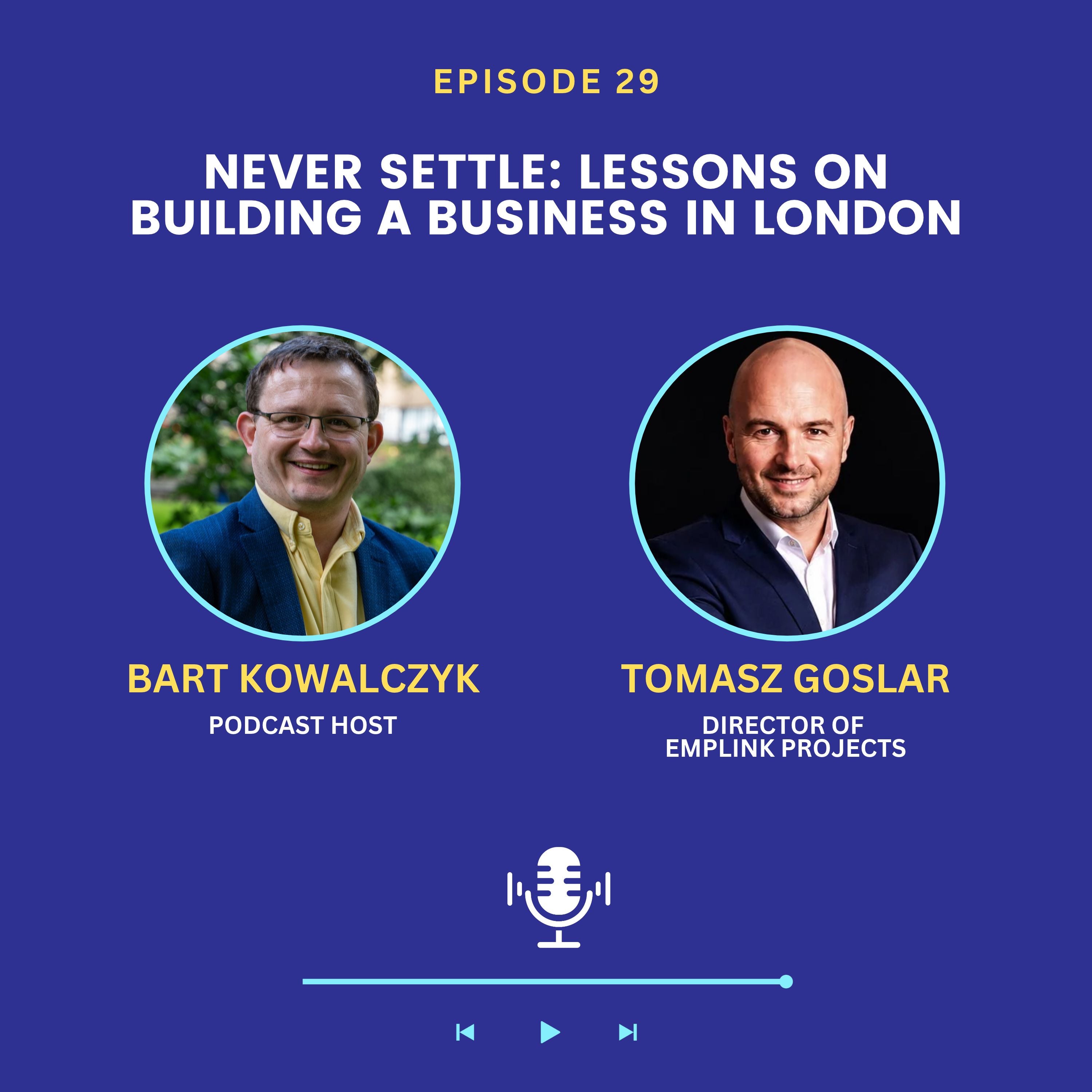
Building a business in construction takes more than skill on site. It takes resilience, reliable people and the ability to adapt when circumstances change. In The Polish Business Podcast, PBLINK’s Bart Kowalczyk spoke with Tomasz Goslar about building construction and recruitment businesses in London.
His story connects complementary partnerships, trusted client relationships and a practical ambition: securing enough suitable work to keep good teams together. It also raises an honest question about construction business growth. When should you diversify, and when should you concentrate on what you already do?
Key takeaways for construction business owners
- Combine complementary skills: Tomasz brought recruitment experience, while his friend and business partner Greg brought construction knowledge.
- Test new services against their commercial results rather than assuming diversification is always better than focus.
- Give trusted employees opportunities to develop into leaders as their contribution grows.
- Plan upcoming projects alongside team capacity to identify gaps in work before they become urgent.
- Build community relationships for advice, shared experience and friendship rather than expecting immediate clients.
From the sports field to the building site
Tomasz graduated in sports management and spent 13 years in the leisure industry. His responsibilities included health and safety and recruitment within an organisation employing around 500 people.
When he felt he had reached a career ceiling, he began exploring a different future with Greg. Their idea combined Greg’s construction knowledge with Tomasz’s recruitment experience and their ability to communicate with clients and workers.
They started the recruitment business in 2017, connecting people with construction companies. Clients later asked them to complete projects directly. Bathrooms led to flats, then houses, blocks of flats and offices.
For your own business, consider which capability you already have and which complementary skill a partner or colleague could bring.
How should construction businesses decide when to diversify?
Diversification deserves testing rather than automatic approval. Alongside construction and recruitment, Tomasz described developing maintenance, cleaning and virtual assistance for construction directors who need help with back-office work.
Some opportunities connected existing resources. Maintenance brought construction capability together with recruitment-side client relationships. Tomasz said smaller jobs and maintenance had generated new contacts, clients and positive financial results.
He was also candid about the uncertainty. Some successful business owners he knows focus on one activity. He did not claim that adding services was always the better strategy.
Before expanding, define the customer problem, delivery responsibilities and financial test. Review margin and management time alongside revenue, and check whether a new service distracts from existing commitments.
Why your first hire can become a future leader
Tomasz’s first hire grew from running the recruitment office to becoming a director of the recruitment business. He described offering a stake in the company to recognise her contribution and give her an opportunity to build something for herself.
As his attention moved increasingly towards construction, leadership on the recruitment side became particularly important. The story illustrates how a role can develop beyond the immediate tasks that prompted the original hire.
Consider how responsibility, decision-making and progression could develop for the people you trust. For practical preparation, PBLINK’s guide to hiring construction staff covers defining roles, checking references and distinguishing temporary from permanent requirements.
Reliable delivery creates stronger client relationships
When Bart asked what made him proud, Tomasz focused on his clients and the relationships behind the projects. He traced recommendations back to being available, resolving problems and continuing to deliver.
“We were there when they needed us.”
For Tomasz, quality becomes visible when difficulties arise on or off site. His account shows how responding to those moments can give clients confidence to recommend a business.
He described a complementary partnership: Greg concentrates on running and completing projects, while Tomasz enjoys building the connections that lead to the next opportunity.
To apply the lesson, give client issues a clear owner, agree when the next update will happen and check that the client considers the problem resolved. These are practical ways to put reliable delivery into daily operation.
Why good construction teams need continuity of work
Finding capable people creates another responsibility: securing suitable work to keep them. Tomasz described the effort involved in recruiting reliable workers, many of whom are already employed.
“Continuity for good people.”
His ambition for 2027 was to have enough projects running to retain good teams. On the recruitment side, he wanted to develop the virtual assistant service and continue winning suitable clients, with financial discipline throughout.
For your planning, compare expected project dates with team availability and flag uncertain starts. Check profitability, payment terms and delivery capacity before accepting work simply to fill a gap.
PBLINK’s interview on construction leadership offers a complementary perspective on building a business around people and systems.
What should entrepreneurs expect from a business community?
A business community can provide trusted peers, advice and friendship even when it does not produce direct clients. Tomasz made that distinction explicitly in his closing comments about PBLINK.
“Hope for having people around you that you can make a phone call to and ask for advice.”
He said he did not really have clients from the community. What he appreciated was access to like-minded people who could exchange views about similar business problems.
PBLINK’s construction forum discussions provide another example of entrepreneurs sharing experience across risk, recruitment and collaboration. Bring a specific challenge to your next conversation and be prepared to help someone else with theirs.
Practical next steps for sustainable construction business growth
Review how your services, client relationships and project pipeline support the team you want to retain. Tomasz’s experience suggests several useful questions for your next business review.
- Review your service mix. Which activities produce a healthy return after delivery costs and your own time?
- Check leadership capacity. Which decisions depend entirely on you, and who could develop responsibility for them?
- Map upcoming work. Where do project timing and team availability leave a potential gap?
- Understand your referrals. Ask clients what gave them confidence to recommend you.
- Build a peer relationship. Arrange a conversation to exchange experience without starting with a sales pitch.
To meet business owners facing similar decisions, explore PBLINK’s events calendar and choose a conversation relevant to your business. Go with a question, listen carefully and follow up with someone whose experience could help you think more clearly.
Listen to the embedded episode above for Tomasz Goslar’s full conversation with Bart Kowalczyk.
FAQs about construction business growth
How can a construction business generate more referrals?
Give clients clear reasons to trust your delivery, particularly when problems arise. Tomasz attributed recommendations to resolving issues and being available when clients needed help. Review how you communicate during difficulties and ask satisfied clients whether they would be comfortable providing a reference.
Should a construction company diversify into additional services?
Diversify when you can identify a customer need and test whether you can serve it profitably. Tomasz explored maintenance, cleaning and virtual assistance but questioned whether diversification was better than focus. Evaluate each service on its results rather than assuming expansion means improvement.
How can construction owners support team retention?
Consider continuity of work alongside recruitment. Tomasz wanted enough suitable projects to retain capable people after finding them. Review project timing, capacity and commercial viability together, while recognising that continuity is one part of retention rather than a guarantee that everyone will stay.
What can PBLINK offer beyond potential client introductions?
PBLINK connects entrepreneurs through a business community where they can exchange experience and build relationships. Tomasz particularly valued advice, friendship and access to people facing similar pressures. His experience shows why a useful peer conversation can matter even when it does not lead to a contract.