

The UK government's immigration landscape is shifting faster than headlines can capture — and the stakes for businesses sponsoring overseas workers have never been higher. From monthly salary monitoring to visa bans on specific countries, here is what every employer and entrepreneur needs to know right now.
UK immigration law sits in a uniquely politically charged space. As noted by immigration specialists at Carter Lemon Camerons during a recent business power session hosted in partnership with Polish Business Link (PBL), changes can — and do — arrive with little public announcement, sometimes implemented directly through the Immigration Rules rather than through primary legislation.
That makes staying informed not merely good practice, but a business-critical imperative.

The Skilled Worker Visa: What Is Changing
For many growing businesses, the Skilled Worker visa is the primary route to bringing international talent to the UK. Two significant changes are underway in 2025.
Monthly Salary Monitoring — A New Compliance Pressure
Previously, the Home Office would check whether a sponsored worker was being paid the salary stated on their Certificate of Sponsorship on an annual basis via PAYE records. From 2025, that monitoring becomes monthly. This has immediate implications for businesses whose payroll cycles do not align with calendar months — for example, workers paid quarterly.
HR and payroll teams must ensure every sponsored worker's monthly PAYE records consistently reflect the salary stated on their Certificate of Sponsorship. If your business operates non-standard pay cycles, review this with your payroll provider immediately. Failure to meet the monthly minimum could trigger a compliance audit.
Higher Qualification Thresholds
New Skilled Worker applicants must now meet RQF Level 6 — broadly equivalent to graduate or degree level. Lower-skilled roles that previously qualified for sponsorship are being removed from the eligible occupations list. The government's stated intent is to end dependency on lower-cost overseas labour in favour of attracting genuinely skilled professionals.
Visa Bans on Specific Nationalities
In a move that has received relatively little mainstream business press coverage, the government has introduced what it terms 'visa bans' — restrictions on applications from certain countries. As of early 2026, this includes Afghanistan (covering both skilled workers and students) and restrictions on students from Cameroon, Sudan, and Myanmar. Employers should monitor the government's Immigration Rules regularly, as this list can change without notice.
Good News: Global Business Mobility Visa Reform
Not all the changes are restrictive. The Global Business Mobility (GBM) visa — designed for international companies bringing employees from their overseas operations to their UK office — has seen a welcome relaxation. The required period of overseas employment before a worker can be transferred to the UK under this route has been reduced from 12 months to 6 months. The total permitted duration of stay in the UK for GBM workers remains up to five years, making this an increasingly viable route for companies expanding into Britain.
For international businesses looking to establish a UK presence — a category that Polish Business Link's membership frequently falls into — this is a meaningful improvement worth exploring with a specialist immigration solicitor.

Settlement and ILR: The Long Game Is Getting Longer
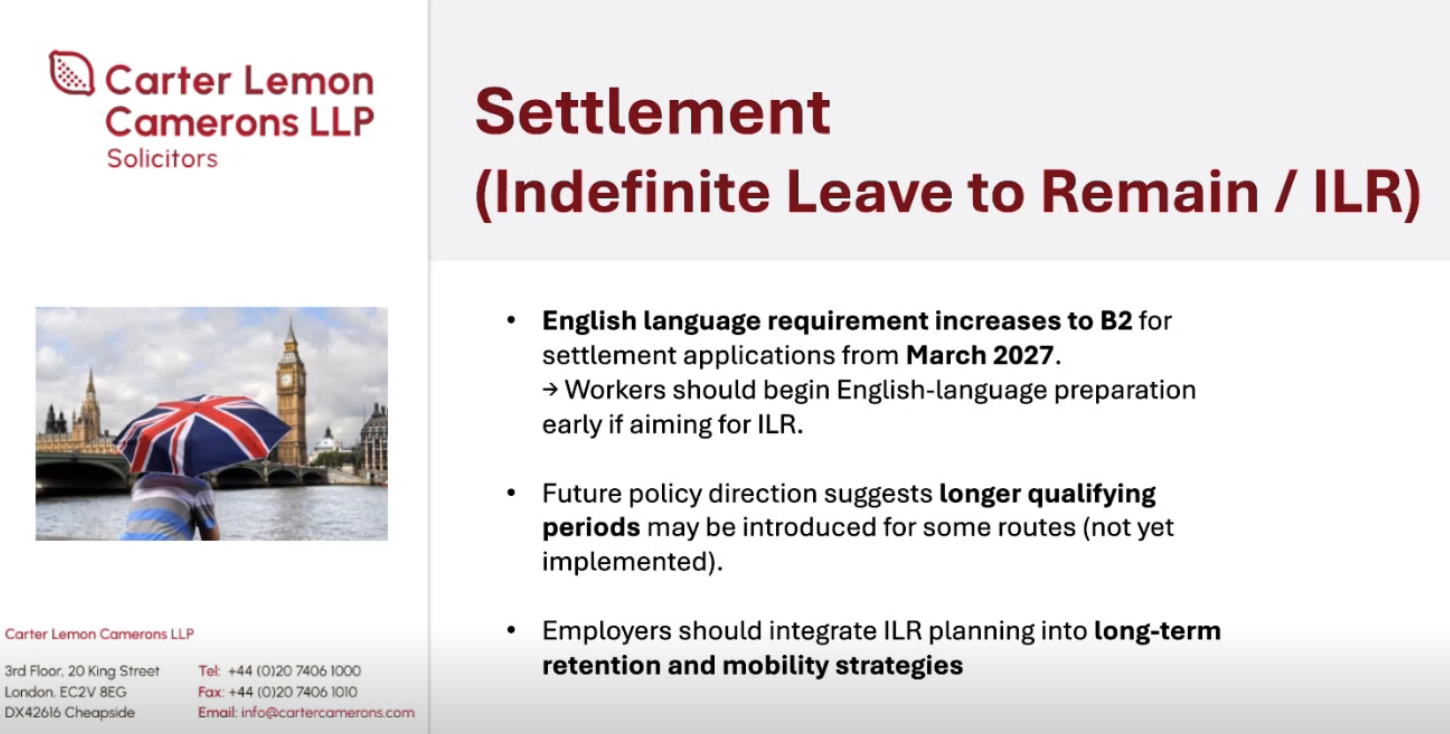
For workers and founders already in the UK and building toward permanent residency (Indefinite Leave to Remain, or ILR), the proposed changes carry significant implications. The current standard ILR route requires five years of continuous residence. The government has signalled it may extend this to 10 or even 20 years, depending on the visa route — a proposal still under active consideration at the time of writing with changes hinted for Autumn 2026.
English language requirements for settlement are also increasing, from B1 to B2 level — roughly equivalent to moving from GCSE to A-Level standard. Workers seeking settlement will need to demonstrate this higher competency, and some will need to take new tests or undertake additional English language courses.
The Right to Work Check: Don't Get This Wrong
The Home Office is actively increasing enforcement around right to work checks — and the consequences for getting it wrong can be severe. Whether an employee holds pre-settled EU status, a work visa, or is a British national, employers must ensure they carry out the correct check for each individual, retain a copy, and store it for at least two years after the employee leaves.
For EU citizens with pre-settled status, ensure you are downloading the right to work confirmation that specifically confirms their permission to work — not merely their right to reside. The check must be completed face-to-face, with two tick-boxes confirming the person matches their photo and the date the check was conducted. Fines — or worse — await employers who fail to comply.
The Design Industry Visa: A New Avenue for Founders
There is welcome news for international entrepreneurs with a design background. A new visa route has been introduced for individuals with demonstrated achievements in the design industry — including startup founders — who wish to establish a business in the UK. Applicants need endorsement from a relevant body in the design sector. This expands the pathways available for internationally-recognised talent to bring their ventures to Britain.
For Polish and European Entrepreneurs: A Practical Word of Advice
Carter Lemon Camerons' immigration specialists offer a clear message to EU and Polish nationals building lives and businesses in the UK: do not rely indefinitely on pre-settled or settled status. Circumstances change — health, personal situations, legal matters — and citizenship offers a level of protection and permanency that time-limited leave does not.
If you have lived in the UK long enough to qualify for naturalisation, it is worth taking advice on your options sooner rather than later.
Key Questions Answered
Q: What are the UK Skilled Worker visa changes in 2025?
A: From 2025, the Home Office monitors sponsored worker salaries monthly rather than annually. New applicants must qualify at RQF Level 6 (degree-level). Visa bans have been introduced restricting applications from Afghanistan and certain other countries.
Q: How long does an employee need to work overseas before transferring to the UK on a Global Business Mobility visa?
A: Following 2025 changes, the required period of overseas employment has been reduced from 12 months to 6 months. Workers can then be posted to the UK for up to five years.
Q: Is the UK ILR settlement period changing?
A: The government has signalled it may extend the ILR qualifying period from 5 years to 10 or even 20 years for some visa routes. The changes have not yet been formally implemented.
Q: What is the English language requirement for UK settlement in 2025?
A: The requirement is increasing from B1 (GCSE equivalent) to B2 (A-Level equivalent). Workers applying for settlement who do not already hold this level will need to take a new test or complete further English language training.